
Oracle, MySQL, Cassandra, Hadoop Database Training Classes in Passaic, New Jersey
Learn Oracle, MySQL, Cassandra, Hadoop Database in Passaic, NewJersey and surrounding areas via our hands-on, expert led courses. All of our classes either are offered on an onsite, online or public instructor led basis. Here is a list of our current Oracle, MySQL, Cassandra, Hadoop Database related training offerings in Passaic, New Jersey: Oracle, MySQL, Cassandra, Hadoop Database Training
Oracle, MySQL, Cassandra, Hadoop Database Training Catalog
Cassandra Classes
Hadoop Classes
Linux Unix Classes
MySQL Classes
Oracle Classes
Course Directory [training on all levels]
- .NET Classes
- Agile/Scrum Classes
- AI Classes
- Ajax Classes
- Android and iPhone Programming Classes
- Azure Classes
- Blaze Advisor Classes
- C Programming Classes
- C# Programming Classes
- C++ Programming Classes
- Cisco Classes
- Cloud Classes
- CompTIA Classes
- Crystal Reports Classes
- Data Classes
- Design Patterns Classes
- DevOps Classes
- Foundations of Web Design & Web Authoring Classes
- Git, Jira, Wicket, Gradle, Tableau Classes
- IBM Classes
- Java Programming Classes
- JBoss Administration Classes
- JUnit, TDD, CPTC, Web Penetration Classes
- Linux Unix Classes
- Machine Learning Classes
- Microsoft Classes
- Microsoft Development Classes
- Microsoft SQL Server Classes
- Microsoft Team Foundation Server Classes
- Microsoft Windows Server Classes
- Oracle, MySQL, Cassandra, Hadoop Database Classes
- Perl Programming Classes
- Python Programming Classes
- Ruby Programming Classes
- SAS Classes
- Security Classes
- SharePoint Classes
- SOA Classes
- Tcl, Awk, Bash, Shell Classes
- UML Classes
- VMWare Classes
- Web Development Classes
- Web Services Classes
- Weblogic Administration Classes
- XML Classes
- Linux Fundaments GL120
14 September, 2026 - 18 September, 2026 - DOCKER WITH KUBERNETES ADMINISTRATION
28 September, 2026 - 2 October, 2026 - Enterprise Linux System Administration
21 September, 2026 - 25 September, 2026 - RED HAT ENTERPRISE LINUX SYSTEMS ADMIN I
26 October, 2026 - 30 October, 2026 - OpenShift Fundamentals
5 October, 2026 - 7 October, 2026 - See our complete public course listing
Blog Entries publications that: entertain, make you think, offer insight
Disruptive technologies such as hand-held devices, cloud computing and social media are rattling the foundations upon which traditional businesses are built. Enterprise customers have grown smarter at ensuring the latest technological trends work in their favor. Everyone is trying to zero in on their core competencies by employing commodity services to run their business.
Likewise, enterprise application vendors need to zero in on their core competencies and enhance more value to the businesses of their clientele by leveraging standards-based commodity services, such as IaaS and PaaS, provided by leaders in those segments (e.g. Amazon EC2, Google Cloud Platform etc.).
What else enterprises need to do is learn to adopt new and emerging technologies such as cloud, utility and social computing to build on them to penetrate new market avenues.
New small and medium-sized entrants into the market are constantly challenging enterprises given their ability to rapidly turnaround and address the requirements of the customers in a cost-effective manner. Additionally, these new advancements also affect how enterprises create, deploy, and manage solutions and applications. If you take the example of Force.com, for instance, you find that it’s a common war zone for enterprise application vendors to furnish SME markets with their applications, with the new entrants mostly having an edge.
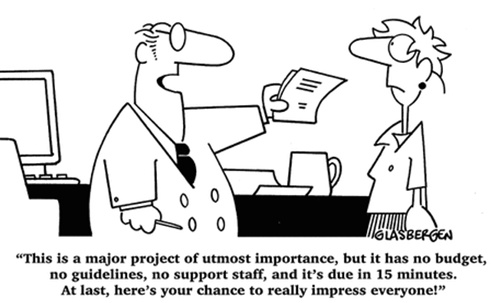 A project manager acts as the primary link between business and technical teams. A project manager is responsible for maintaining the project schedule, developing project estimates, working with external teams and tracking project issues. The project manager belongs to either the technical team or the project management office (PMO). The project manager works with business teams, technical teams, business counterparts, testing resources, vendors and infrastructure teams.
A project manager is often challenged with diagonally opposite views from the business side and technical side. A project manager’s success depends on balancing the needs and emotions of both sides.
Understanding the Requirements
A project manager must familiarize with the project’s requirements as defined by the business or product managers. This will help you understand the business vision behind the project. You will need this knowledge while negotiating with the technical teams.
Understanding the Technical Landscape
A project manager must also understand the technical systems, resource skills and infrastructure capabilities available for the project. Business teams come up with expectations that are sometimes beyond the capabilities of the technology team. It is the responsibility of the project manager to understand the technical capabilities available to the project.
Walkthrough of Business Requirements
This is a critical step in the project delivery process. The project manager must invite members from the business team, technical team, testing team, infrastructure team and vendors. The project manager must encourage the various stakeholders to ask questions about the requirements. Any prototypes available must be demonstrated in this meeting. The project manager must find answers to all questions resulting from the requirements walkthrough. The project manager must get the final version of the requirements approved by all stakeholders.
Managing Conflicts in Timelines and Budgets
All project managers will face the conflicts arising from shortened timelines and limited budgets. Business teams typically demand many features that are nearly impossible to deliver within short timeframes. The project manager must work with business and technical teams to prioritize the requirements. If the project is executed in a product development organization, then the project manager could utilize agile methodologies to deliver projects incrementally. In this case, the project manager may be required to act as a scrum master to facilitate scrum meetings between various stakeholders.
The Art of Saying “No”
As a project manager, you may be forced to say “no” to demands from both business and technology teams. However, it is important to create a win-win situation for all parties when you are faced with conflicting demands. You can work with the stakeholders individually before bringing all parties together. Most stakeholders prefer to work together. The success of a project manager depends on how effectively he or she can bring out the best in everyone, driving everyone towards a common goal.
Finally, the job of a project manager is not to satisfy the demands from all corners. The project manager must identify the essential deliverables that will meet the business needs, with a solid understanding of what is possible within the limits of technology.
Related:
If you’re interested in building modern websites or applications which use ASP, XML, or mobile technology, you’ve heard of Visual Studio .NET. It is one of the more popular suites of development tools available to aspiring programmers, as it consolidates several different tools and languages into the same development environment, which helps in turn to integrate this code across development languages. Here are three important benefits to using the visual studio suite:
· Use of Visual J# - This development tool is specifically oriented towards people who already are familiar with basic Java syntax, and is designed for use by those people to build apps or services which will then run on the Microsoft .NET Framework. This is useful because it fully supports Microsoft Extensions, among other reasons. Visual J# was developed completely independently by Microsoft.
· Utility for Smart Devices – Another huge benefit of using visual studio .NET is the ability to immediately integrate your programming efforts with deployment across a variety of smart devices. PDAs, smartphones, Pocket PCs, and any device which has a limited amount of resources all require a compact framework for the programming of applications it is designed to run.
· XML Web Usage and Support – Because XML services aren’t married to any particular technology or programming language, they can be accessed by any system, and this broad-based utility has made the services increasingly popular. Visual Studio .NET takes advantage of this by fully integrating with XML services, including the ability to create and edit them from scratch.
Tech Life in New Jersey
| Company Name | City | Industry | Secondary Industry |
|---|---|---|---|
| HCB, Inc. | Paramus | Retail | Office Supplies Stores |
| Wyndham Worldwide Corp. | Parsippany | Travel, Recreation and Leisure | Hotels, Motels and Lodging |
| Realogy Corporation | Parsippany | Real Estate and Construction | Real Estate Agents and Appraisers |
| Church and Dwight Co., Inc. | Trenton | Manufacturing | Manufacturing Other |
| Curtiss-Wright Corporation | Parsippany | Manufacturing | Aerospace and Defense |
| American Water | Voorhees | Energy and Utilities | Water Treatment and Utilities |
| Cognizant Technology Solutions Corp. | Teaneck | Computers and Electronics | IT and Network Services and Support |
| The Great Atlantic and Pacific Tea Co. - AandP | Montvale | Retail | Grocery and Specialty Food Stores |
| COVANCE INC. | Princeton | Healthcare, Pharmaceuticals and Biotech | Pharmaceuticals |
| K. Hovnanian Companies, LLC. | Red Bank | Real Estate and Construction | Architecture,Engineering and Design |
| Burlington Coat Factory Corporation | Burlington | Retail | Clothing and Shoes Stores |
| GAF Materials Corporation | Wayne | Manufacturing | Concrete, Glass, and Building Materials |
| Pinnacle Foods Group LLC | Parsippany | Manufacturing | Food and Dairy Product Manufacturing and Packaging |
| Actavis, Inc | Parsippany | Healthcare, Pharmaceuticals and Biotech | Pharmaceuticals |
| Hudson City Savings Bank | Paramus | Financial Services | Banks |
| Celgene Corporation | Summit | Healthcare, Pharmaceuticals and Biotech | Biotechnology |
| Cytec Industries Inc. | Woodland Park | Manufacturing | Chemicals and Petrochemicals |
| Campbell Soup Company | Camden | Manufacturing | Food and Dairy Product Manufacturing and Packaging |
| Covanta Holding Corporation | Morristown | Energy and Utilities | Energy and Utilities Other |
| New Jersey Resources Corporation | Wall Township | Energy and Utilities | Gas and Electric Utilities |
| Quest Diagnostics Incorporated | Madison | Healthcare, Pharmaceuticals and Biotech | Diagnostic Laboratories |
| Rockwood Holdings Inc. | Princeton | Manufacturing | Chemicals and Petrochemicals |
| Heartland Payment Systems, Incorporated | Princeton | Financial Services | Credit Cards and Related Services |
| IDT Corporation | Newark | Telecommunications | Wireless and Mobile |
| John Wiley and Sons, Inc | Hoboken | Media and Entertainment | Newspapers, Books and Periodicals |
| Bed Bath and Beyond | Union | Retail | Retail Other |
| The Children's Place Retail Stores, Inc. | Secaucus | Retail | Clothing and Shoes Stores |
| Hertz Corporation | Park Ridge | Travel, Recreation and Leisure | Rental Cars |
| Public Service Enterprise Group Incorporated | Newark | Energy and Utilities | Gas and Electric Utilities |
| Selective Insurance Group, Incorporated | Branchville | Financial Services | Insurance and Risk Management |
| Avis Budget Group, Inc. | Parsippany | Travel, Recreation and Leisure | Rental Cars |
| Prudential Financial, Incorporated | Newark | Financial Services | Insurance and Risk Management |
| Merck and Co., Inc. | Whitehouse Station | Healthcare, Pharmaceuticals and Biotech | Pharmaceuticals |
| Honeywell International Inc. | Morristown | Manufacturing | Aerospace and Defense |
| C. R. Bard, Incorporated | New Providence | Healthcare, Pharmaceuticals and Biotech | Medical Supplies and Equipment |
| Sealed Air Corporation | Elmwood Park | Manufacturing | Plastics and Rubber Manufacturing |
| The Dun and Bradstreet Corp. | Short Hills | Business Services | Data and Records Management |
| The Chubb Corporation | Warren | Financial Services | Insurance and Risk Management |
| Catalent Pharma Solutions Inc | Somerset | Healthcare, Pharmaceuticals and Biotech | Healthcare, Pharmaceuticals, and Biotech Other |
| Becton, Dickinson and Company | Franklin Lakes | Healthcare, Pharmaceuticals and Biotech | Medical Supplies and Equipment |
| NRG Energy, Incorporated | Princeton | Energy and Utilities | Gas and Electric Utilities |
| TOYS R US, INC. | Wayne | Retail | Department Stores |
| Johnson and Johnson | New Brunswick | Healthcare, Pharmaceuticals and Biotech | Pharmaceuticals |
| Automatic Data Processing, Incorporated (ADP) | Roseland | Business Services | HR and Recruiting Services |
training details locations, tags and why hsg
The Hartmann Software Group understands these issues and addresses them and others during any training engagement. Although no IT educational institution can guarantee career or application development success, HSG can get you closer to your goals at a far faster rate than self paced learning and, arguably, than the competition. Here are the reasons why we are so successful at teaching:
- Learn from the experts.
- We have provided software development and other IT related training to many major corporations in New Jersey since 2002.
- Our educators have years of consulting and training experience; moreover, we require each trainer to have cross-discipline expertise i.e. be Java and .NET experts so that you get a broad understanding of how industry wide experts work and think.
- Discover tips and tricks about Oracle, MySQL, Cassandra, Hadoop Database programming
- Get your questions answered by easy to follow, organized Oracle, MySQL, Cassandra, Hadoop Database experts
- Get up to speed with vital Oracle, MySQL, Cassandra, Hadoop Database programming tools
- Save on travel expenses by learning right from your desk or home office. Enroll in an online instructor led class. Nearly all of our classes are offered in this way.
- Prepare to hit the ground running for a new job or a new position
- See the big picture and have the instructor fill in the gaps
- We teach with sophisticated learning tools and provide excellent supporting course material
- Books and course material are provided in advance
- Get a book of your choice from the HSG Store as a gift from us when you register for a class
- Gain a lot of practical skills in a short amount of time
- We teach what we know…software
- We care…